Hello coffee lovers! ☕
June showed up the way it always does here. All at once. The light turns thick and golden, the sea gets warmer, and the whole city slows down half a step in the heat.
This month I've been circling one question. Not how to do the work. How to know it's the right work.
Einstein put it best, almost a century ago:
"The formulation of a problem is often more essential than its solution."Albert Einstein
I'm still deep in the new domain I started learning back in spring. The deals I mentioned last time are still moving, some clearer now, some not at all. And in the middle of all of it, I keep noticing the same thing: the hard part is almost never the doing. It's choosing what deserves the doing. Which problem. Which deal. Which version of next year.
Then two things I read this month said exactly that, from completely different directions. Sixty years and a whole discipline apart. One was a study of art students. The other was a talk by a mathematician. Underneath, both were about the same quiet skill: finding the right problem before you fall in love with solving the wrong one.
So, coffee in hand, here's June.
Here's what's brewing on this month's menu:
- Art - The art school experiment that redefined creativity 🎨
- Personal Growth - Hamming, and the art of working on what matters 🎯
- Art - Who owns a color, and the feud over the blackest black 🖤
- Tech & History - Alan Turing, the man who imagined thinking machines 🧮
- Photography - The first photograph ever taken 📷
- Sports & Science - The secret grass under the World Cup ⚽
- Word Bites - Aporia 🗣️
- June in History 🌍
- Recommendations - a biblical epic, a revenge classic, African beats for the kitchen 🌟
The Art School Experiment 🎨
↑ topPicture an art studio in 1964.
Thirty-one students, one at a time. Twenty-seven objects laid out on a table: a bunch of grapes, a steel gearshift, an antique book, a glass prism. Each student gets one hour.
Choose any of the objects, arrange them, draw.
In the corner, a researcher watches. Taking notes on everything.
His name was Mihaly Csikszentmihalyi, a psychologist who would spend his career studying creativity and what it feels like to be so absorbed in your work that you forget the time. Right now, in 1964, he just wants to know how artists actually begin.
Here's what he and his colleague Jacob Getzels, both at the University of Chicago, saw.
About half the students knew what they wanted almost right away. They picked their objects, set them down, sketched an outline, and spent the rest of the hour perfecting it. Efficient. Confident. Done.
The other half did something stranger. They picked objects up and put them down. Turned them over. Rearranged. Switched materials. Erased. Started again. Some were still exploring at the fifty-minute mark, then scrambled to finish anything at all before the hour ran out.
The first group treated the hour as a problem to solve.
The second group spent it finding the problem worth solving.
The critics rated the finders' work more original. And five years later, the gap had hardened into careers:
| The hour was... | How they worked | Where they landed |
|---|---|---|
| A problem to solve | Chose fast, sketched, polished | 8 of the 11 had quit art |
| A problem to find | Explored, rearranged, hesitated | The ones still painting 🎨 |
"Problem finding may well be at the origin of the creative process."Mihaly Csikszentmihalyi
I think about this a lot, because my whole job is a version of that studio.
Anyone can solve the problem on the table. The work that matters is figuring out whether it's even the right problem. The brief that lands on your desk is almost never the real one. The feature someone "needs" is rarely the thing they actually need.
The students who drew fastest looked the most productive in the room. They were also the ones who quietly disappeared.
The friction was the point.
Read more: the full write-up in the MIT Press Reader.
The Lunch Table Question 🎯
↑ topIn 1986, a mathematician named Richard Hamming gave a talk called "You and Your Research." He'd spent his whole career around brilliant people, and he kept circling one question: why do some of them do work that lasts, and others don't?
His answer started at the lunch table.
He sat with the chemists and kept asking the same thing: what are the important problems in your field, and why aren't you working on them? They stopped inviting him.
One man, Dave McCall, kept thinking about it. He didn't change his research, he just started taking the question seriously. He ended up running the department! Hamming never heard another name from that table again.
"If you don't work on an important problem, it's unlikely you'll do important work."Richard Hamming
Obvious. Almost nobody does it. The rest of the talk is why:
| Hamming's rule | In plain words |
|---|---|
| Go where things happen | Don't pick safe, quiet work. Stay close to the big questions, where a breakthrough is even possible. |
| Pick problems you can start | A problem isn't important just because the prize is big. You need a real way in, or it stays a daydream. |
| Make time to think big | He kept Friday afternoons for the big questions only. Time spent on where you're going, not just what's in front of you. |
| Keep your door open | A closed door gets more done today. An open door keeps you close to what actually matters. |
| Small effort adds up | One extra hour of real thinking a day doesn't just add up over a life. It multiplies. |
Same lesson as the art studio, in one line:
The work isn't the hard part. Choosing what to work on is.
Read more: Hamming's full talk, "You and Your Research".
Who Owns a Color? 🖤
↑ topYou know how much I love design, art, color, all of it. This one is a story about a single color, and who's allowed to own it.
In 2014, a British company invented one of the blackest substances ever made. Vantablack. It swallows about 99.96% of the light that hits it. Coat an object in it and your eyes can't find the shape. It just reads as a hole cut out of reality.
Then it got strange.
In 2016, the artist Anish Kapoor secured the exclusive rights to use Vantablack in art. One man. The blackest black on Earth, licensed to a single person.
Yes. Apparently that's a thing you can do.
Other artists were furious. Not about the material. About the idea that a color could be owned.
So one of them fought back. Stuart Semple made "the world's pinkest pink," a screaming neon powder, and sold it to anyone for a few pounds. Anyone except Anish Kapoor. To buy it, you had to confirm you weren't him, and wouldn't pass it to him.
Kapoor got hold of some anyway. He posted a photo of his middle finger dipped in pink.
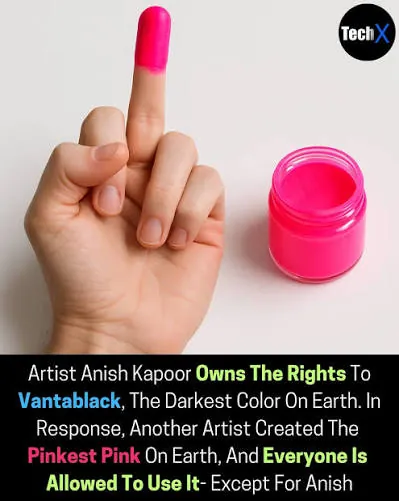
Semple kept going. He released his own super-black, cheap, on purpose, for everyone.
Underneath the pettiness is a real question, and it's older than both of them. Can anyone own something as basic as a color?
The blue of a Tuesday sky. One specific red. Is that a thing you make, or a thing you fence off?
The fight is funny. The question isn't.
The Man Who Imagined Thinking Machines 🧮
↑ topEvery conversation we have about AI started, quietly, with one man. And this month would have been his birthday.
In 1936, years before anyone had built a real computer, Alan Turing described one. On paper. A machine that could follow any set of instructions at all, the idea sitting underneath every device you own.
Then the war came. At Bletchley Park, he helped crack Enigma, the code the Nazis believed was unbreakable. Historians think it shortened the war by around two years.
Sit with that... two years of what that war meant, in human lives.
In 1950 he asked a question nobody was ready for: can machines think? He even designed a test for it. We're still arguing about that test seventy-five years later, every time a chatbot feels a little too human.
And then.
In 1952, Britain convicted him for being gay, still a crime at the time. They offered him prison or chemical castration. He took the injections. Two years later he was dead, at 41. Most likely by his own hand.
The man who helped save the country was broken by it.
It took until 2013 for a formal pardon. Decades too late, for the person who dreamed up the machine I'm typing this on.
Sometimes the people who build the future don't get to live in it.
The First Photograph 📷
↑ topYou probably know I'm a sucker for beauty and details. For photography, for the one frame nobody else stopped to notice. (A lot of it ends up on my Instagram.) So this one's for the photo lovers.
Around 1826, in a French village, a man named Joseph Nicéphore Niépce set a box on his windowsill, an early kind of camera, and aimed it at the view outside.
Then he waited.
Not a second. Not a minute. Eight hours, at least. The plate inside, coated with a sticky substance that reacted to light, slowly held onto whatever the sun touched.
What came out is blurry. Some rooftops. A courtyard. A tree. You can barely make it out. And it's the oldest photograph that still exists, View from the Window at Le Gras. The first time a human being caught a piece of light and made it stay.
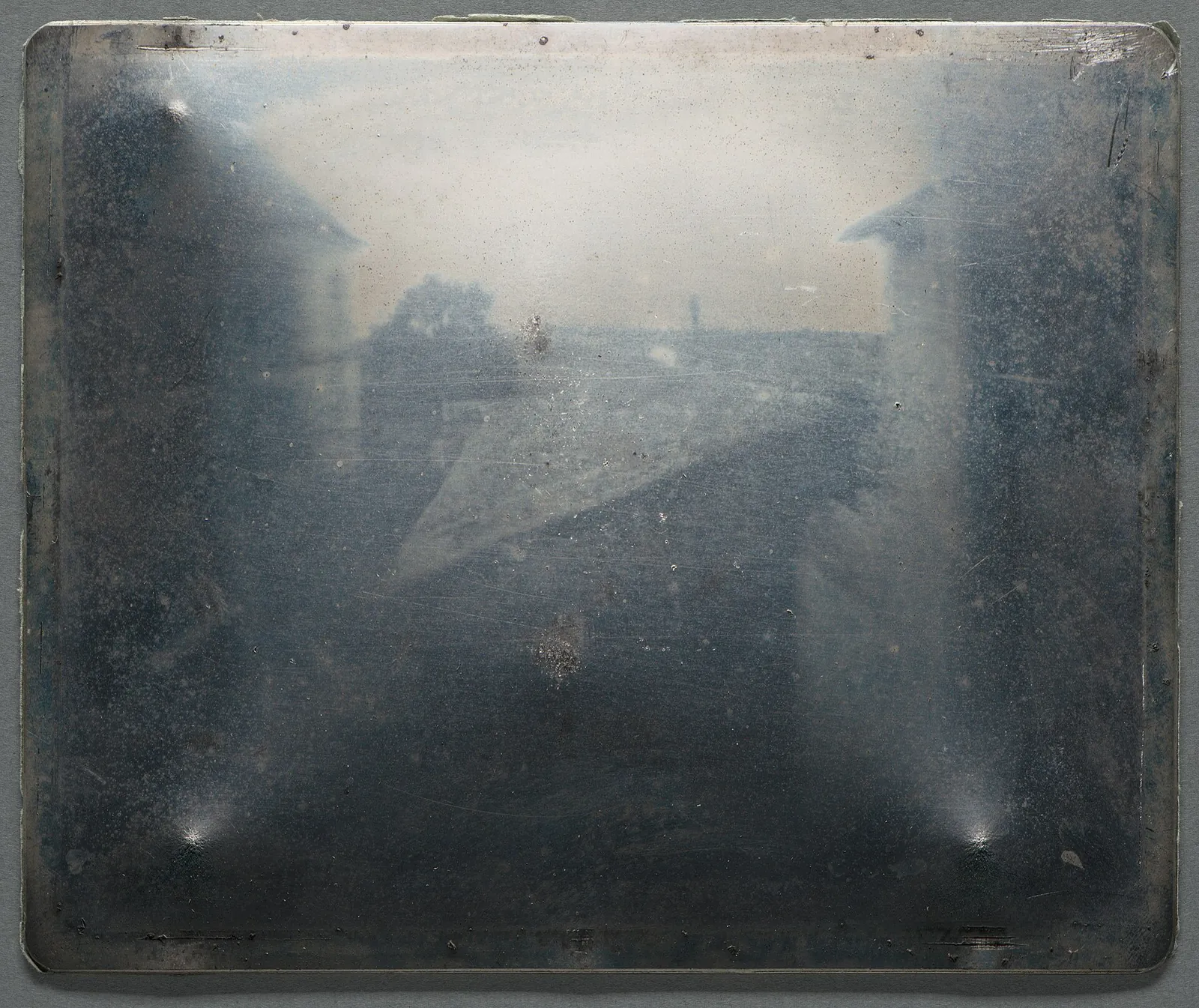
The exposure took so long that the sun moved clear across the sky while the picture formed. That's why the buildings are lit on both sides at once, morning and afternoon caught in the same frame. It's almost a photo of time itself, not just a place.
We take something like two trillion photos a year now. Two trillion. Most of them get one quick look, and then we scroll on.
The first one took eight hours, and it was a smudge of rooftops nobody asked for.
I think about that every time I almost don't bother to really look at something.
Two hundred years later, we're still looking at it.
The Secret Grass Under the World Cup ⚽
↑ topNot many of you know this, but I'm a huge fan of the big tournaments. The World Cup, the Champions League, the giant ones. I'm watching this one closely, and yes, I'm in a little betting pool with friends. I started near the top. I've since slid toward the bottom. Fingers crossed I claw my way back and win something, or at least keep my dignity. 🤞
The World Cup is happening right now, the biggest one ever. 48 teams, 104 matches, three countries.
And the most quietly insane story of the whole thing is the grass.
Here's the problem. Eight of the venues normally sit on artificial turf (fake plastic grass), most of them American-football stadiums. Five have roofs. FIFA's rule doesn't bend: World Cup matches are played on real, living grass. So someone had to grow lawns, identical lawns, that play exactly the same in a sealed Dallas dome and an open field in Seattle.
It took two universities, around eight years, and millions of dollars. Ka-ching. 💸
The grass is grown on plastic sheets at farms, sometimes a full year ahead, then cut into rolls that can weigh close to a ton and driven across the country in refrigerated trucks. For the domed stadiums, where sunlight never reaches the field, they hang racks of pink grow lights and use a grass native to the British Isles, because it's used to living without much sun.
They fire balls at the finished surface at 55 miles an hour to check the bounce. They measure the light on their hands and knees.
And here's the part I keep thinking about.
If they do the job perfectly, you will never once notice it. That's the whole point. Billions of people will watch, and the thing the most care went into is the one thing nobody is supposed to see.
"We treat this almost like one of our own children," one of them said.
The most-watched event on the planet, and its quiet heroes spent eight years on a lawn they're hoping you look straight past.
Read more: how they engineered it, in Scientific American.
Word Bites! 📚✨
↑ topAporia (ἀπορία, Greek)
Pronounced uh-POR-ee-uh.
The state of being at a loss. A puzzle with no obvious way through. The moment you realize you don't actually know the thing you were sure you knew.
Most of us do the opposite. We walk in sure we already know, and that's usually the first mistake, in a conversation, a problem, almost anything. The braver move is to admit you don't even know what you don't know yet.
The Greeks didn't treat it as failure. For them, aporia was the doorway. The productive confusion that has to come before any real thinking starts. Socrates spent his whole life walking people into it on purpose.
It's the exact place those art students lived in for fifty minutes. The discomfort of not knowing yet. The part most of us rush to get out of as fast as we can.
Turns out it's where the good work begins.
June in History 🌍
↑ top- June 12, 1942 - Anne Frank gets a diary for her 13th birthday 📔 She starts writing a few days later. The book outlives everyone who tried to erase her.
- June 21, 1948 - Columbia releases the first LP record 🎶 The 33⅓ vinyl album is born. Music stops being four minutes a side and becomes room for a whole symphony, a whole story.
- June 8, 1949 - George Orwell's Nineteen Eighty-Four is published 📖 "Big Brother." "Doublethink." "Thoughtcrime." One novel handed us half the words we still reach for whenever we worry about being watched.
- June 16, 1963 - Valentina Tereshkova becomes the first woman in space 🚀 A textile worker from a small village, alone in orbit for three days. Twenty years before any American woman.
- June 10, 1977 - the Apple II goes on sale 💻 The personal computer stops being a hobbyist's toy and walks into the living room.
Recommendations 🌟
↑ topWhat I'm watching / listening to this month:
📺 Series - House of David
The story of Saul and David. The outcast shepherd boy who becomes a king. Big, sweeping, and more emotional than I expected, even though you already know how it ends. I loved it. Very interesting to see it actually played out on screen instead of read on a page. On Prime Video.
🎬 Film - The Count of Monte Cristo (2002)
Went back to the 2002 version this month. On the surface, a revenge story. Underneath, it's about the betrayal that cuts deepest, the one that comes from your closest friend, not a stranger. Revenge keeps Edmond alive, but it almost becomes another cell. The whole thing folds into two words: "Wait and hope."
🎧 Listening - African beats for the kitchen
My playlist of the month. Rhythmic, warm, alive. Perfect for deep work, and even better for cooking, when I want the kitchen to feel like somewhere else for an hour.
Wrap-Up
That's June. Or the start of it.
Fingers crossed, I have a feeling some things are about to reveal themselves.
In the meantime, the sea is warm again. So I'll be there. On the bike, then in the water, then at a cafe with a book and no agenda.
I'm also here:
You made it all the way here... thank you for sharing this coffee with me ☕❤️
Ciao!
, Tanya
If this piece was forwarded to you, sign up now to never miss a monthly edition!
Liked this edition? Get the next one in your inbox, once a month.