A landing page is one page built for one action: book, buy, sign up. It works when you send the traffic yourself, through ads or social. A full website is a set of indexable pages that can rank on Google and be cited by AI tools like ChatGPT. If you need customers to find you, you need a website. If you're driving paid or social traffic to a single offer, a landing page is enough.
TL;DR
- The real difference is who brings the traffic. A landing page converts visitors you pay for; a website earns visitors from search and AI answers.
- A single page is nearly invisible to Google and to AI engines: one shot at ranking, almost nothing to cite.
- Instagram and a Google Business Profile aren't a substitute. Instagram's robots.txt blocks GPTBot, ClaudeBot and PerplexityBot, so assistants literally can't read your feed.
- Real 2026 prices: a few hundred dollars for a landing page, $3,000 to $15,000 for a professional site, or subscription builders from about $100 per month.
- Not sure? Start with a landing page on your own domain and grow it into a website. The migration path is below.
Almost every article about this question is written by a company selling a landing page builder or a website builder, and the answer conveniently matches the product. I build both for clients, so my only stake here is that you build the right thing. Sometimes that's the cheaper thing, and yes, I'll tell you when it is. Terrible sales strategy. Great clients. Let's take the question apart properly.
What's the difference between a landing page and a website?
A landing page is a single page with one goal and one call to action, usually attached to a campaign: sign up, book a call, buy the offer. A website is a connected set of pages, home, services, about, contact, articles, that together tell search engines and AI assistants who you are, what you do, and why to recommend you.
| Landing page | Full website | |
|---|---|---|
| Purpose | Convert one specific visitor to one action | Be found, build trust, convert many kinds of visitors |
| Pages | One | Usually 5 or more, growing over time |
| Traffic source | You bring it: ads, social, email | It earns its own: Google, AI answers, referrals |
| Time to launch | Days | 2 to 6 weeks for a professional build |
| Typical 2026 cost | $0 to ~$2,000 | $3,000 to $15,000, or ~$100 to $300 per month |
| What Google can do with it | Rank it for one query, maybe | Rank many pages for many queries |
| What AI engines can do with it | Almost nothing to cite | Question-shaped pages they can quote and recommend |
The row that matters most is the traffic source.
Everything else, cost, page count, launch time, follows from whether you plan to pay for every visitor or want visitors to arrive on their own.
Can a landing page replace a website?
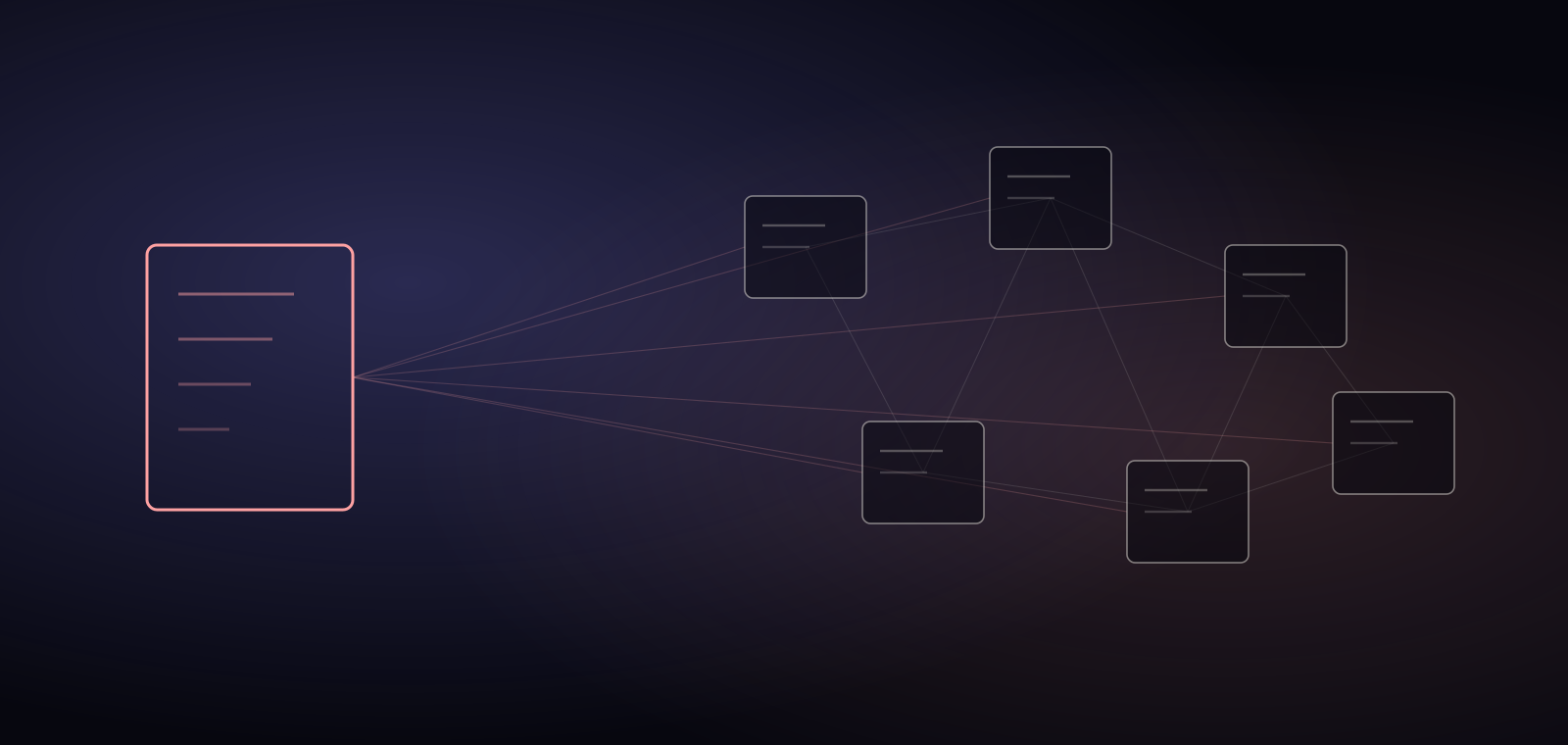
In my opinion, the answer is no, and the reason is the part almost nobody selling landing pages will tell you: a single page is nearly invisible to Google and to AI search.
Google ranks pages, not businesses. One page gives you one shot at ranking for roughly one search phrase. There's no page answering "how much does X cost," no page for each service, no article demonstrating expertise. Search engines read topical depth as trust, and a landing page has none to offer.
The AI side is newer, and here is the part I most need you to hear: AI search isn't a separate universe. It stands on the shoulders of the classic search engines, mostly Google's. Google's AI Overviews and AI Mode are built directly on Google's index and rankings; this isn't my interpretation, it is Google's own documentation:
"The best practices for SEO continue to be relevant because our generative AI features on Google Search are rooted in our core Search ranking and quality systems."
Google Search Central, guide to succeeding in AI search
ChatGPT is the same story with a different engine underneath: its web answers retrieve through Bing, and Seer Interactive's analysis of 500+ citations found that 87% matched Bing's top organic results. So when someone asks ChatGPT or Perplexity "who is the best family lawyer in my city," the engine assembles its answer from pages that already rank somewhere and can be read and quoted. A landing page with a headline, three benefits, and a form gives it nothing to work with, and no rankings to inherit.
If you're invisible in classic search, you're invisible to the AI layer built on top of it.
Research backs this up from the content side too: the Princeton GEO study (Aggarwal et al., KDD 2024) found that pages with quotable statistics and clear sourcing gained up to about 40% more visibility in generative-engine answers, and that lower-ranked sites gained the most. That last part is the small-business opportunity: AI answers are an equalizer, but only for businesses whose sites give the engines something to cite.
Two more numbers worth your attention.
SparkToro's Rand Fishkin ran nearly 3,000 prompts across ChatGPT, Claude, and Google's AI in late 2025: the recommendations shuffle almost every run, yet the best-known brands still appeared in 55-77% of answers regardless of phrasing. Presence is earned by depth and consistency, not by one lucky page. And those visitors are worth having: analyses by Seer Interactive and Semrush consistently find that visitors arriving from AI answers convert at a multiple of classic organic visitors, because they arrive pre-sold. A landing page opts you out of that channel entirely.
Do you even need a website if you have Instagram or a Google Business Profile?
Yes, if you want to be found by people who don't already follow you.
Social profiles and a Google Business Profile are necessary, and not sufficient.
The version of this I meet most often looks like this:
BrightLocal's Local Consumer Review Survey puts numbers on the cross-check buyers actually run: consumers evaluate local businesses through Google (71%), Facebook, and, already in third place, ChatGPT and AI tools (45%). A business that exists only on Instagram fails that check. There's no site to verify prices, no page answering the buyer's real questions, nothing for Google to rank beyond a profile card.
Three structural reasons a feed can't do this job, none of which better content fixes:
1. You rent the land, and the rent keeps rising. Organic reach on social has been falling for years; Rival IQ's social media benchmark report measured engagement rates dropping across every major platform in 2025, Facebook down 36%, Instagram down 16%, TikTok down 34%, and X down 48%. The algorithm decides who sees you, and its trend line points one way.
2. One password reset from zero. A hacked account, a mistaken restriction, a policy change, and the audience you built for years is unreachable. There's no support hotline. Every owner who has been through this tells the same story, and it always starts with "overnight".
3. Search engines barely see it. Google can surface your profile, but your posts, prices, and answers live inside an app that classic search barely indexes. The person googling "your specialty + your city" finds whoever has a page about it.
The 2026 version of the argument is sharper, and you can verify it yourself in ten seconds. Open instagram.com/robots.txt, the file that tells crawlers what they may read, and look at the top:
"Collection of data on Instagram through automated means is prohibited..." followed by:User-agent: GPTBot, Disallow: /·User-agent: ClaudeBot, Disallow: /·User-agent: PerplexityBot, Disallow: /
instagram.com/robots.txt, as of July 2026
Instagram blocks the crawlers of ChatGPT, Claude, and Perplexity, plus Google-Extended, at the front door. Whatever you post there, the AI layer can't read it, so it can't recommend you based on it. The assistants quote what they can read instead: websites, reviews, directories.
So the businesses losing these recommendations aren't losing to better competitors. They are losing to competitors with pages the engines can quote.
Then keep posting on Instagram. Seriously 🙂 Let each channel do its job: the feed builds the relationship, the website gets you found, and the link in your bio connects them.
When is a landing page all you need?
A landing page is the right call when you bring the audience yourself and need one action from them. Honest examples:
- Testing a new offer. You want to know if anyone will pay before investing in a full build. A landing page plus a small ad budget answers that in weeks.
- A campaign with paid or social traffic. Ads should land on a page built for exactly that ad, not on a generic homepage.
- An event, a launch, a waitlist. One action, one deadline, one page.
- A personal audience. If your clients come from your newsletter, community, or speaking, they don't need to find you on Google. They already have the link.
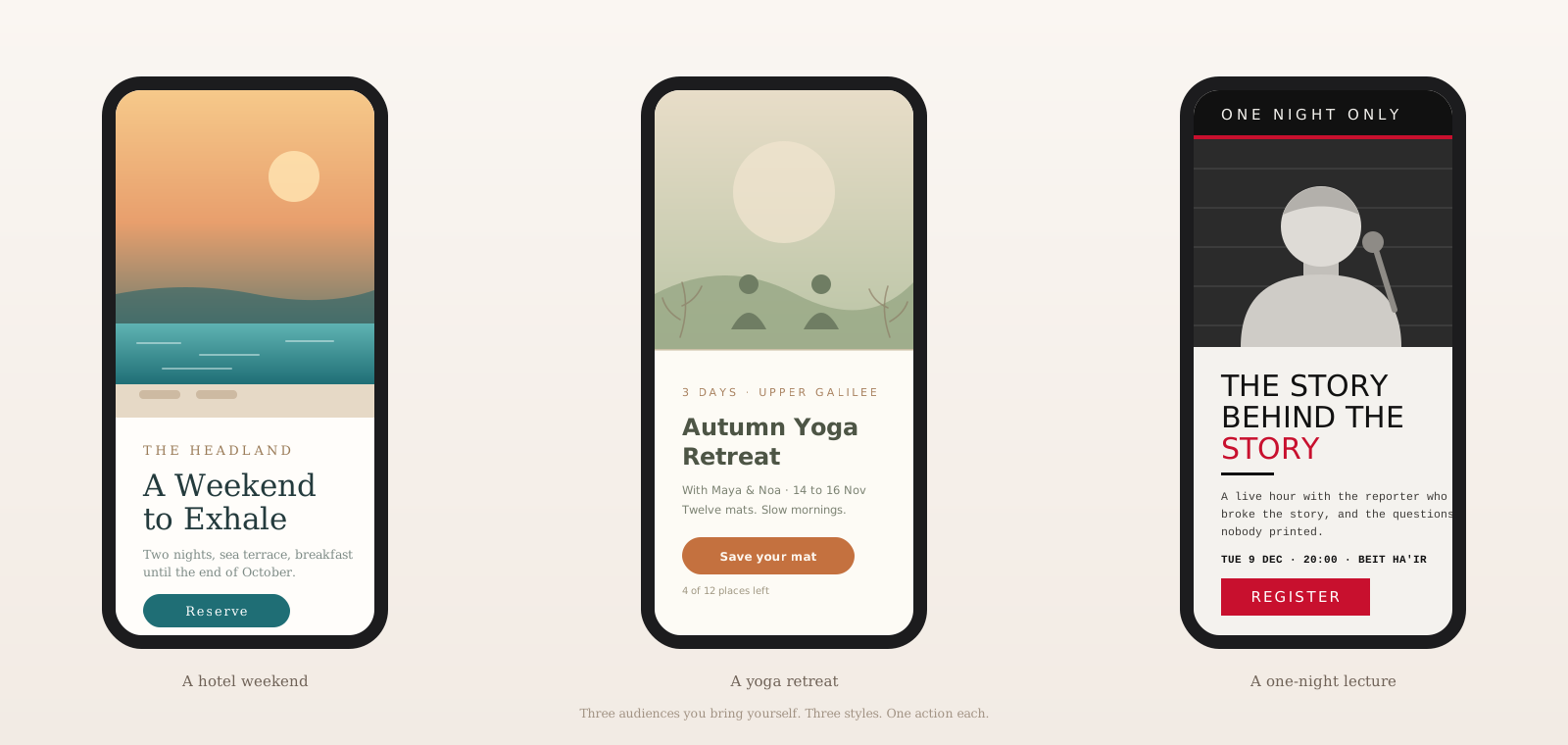
For any of these, a builder like Carrd, Framer or Wix does the job well. Plenty of good landing pages live on one, and building it yourself over a weekend is a perfectly reasonable way to start.
When do you need a full website?
You need a full website the moment your growth depends on people who have never heard of you finding you. The signs:
- Your clients search before they buy. Lawyers, clinics, studios, consultants, trades: if people google or ask ChatGPT before choosing, the answer engine needs pages about you to work with.
- You sell more than one thing. Each service deserves its own page, targeting its own searches.
- Trust decides the sale. Reviews, cases, an about page, real answers to real questions. That takes pages, not a scroll.
- You're tired of renting traffic. Ads stop the moment you stop paying. Pages that rank keep working, and compound.
This is the job my hand-coded small business websites are built for: every page structured as answers Google can rank and AI engines can cite, from day one.
What about a one-page website, the middle option?
A one-page website, a single long scrolling page with sections for services, about, and contact, is a legitimate budget option, and it inherits most of the landing page's search limits. One URL still means one shot at ranking. If you go this route, structure each section as a real answer with question-shaped headings and schema markup, and treat it as a starting point: the sections are the outline of the multi-page site you will grow into, not the final destination.
How much does each cost in 2026?
Every cost article says "it depends." While writing this piece I opened a few dozen pricing pages; most turned out to be a contact form. "Contact us" isn't a price. So here are actual numbers, in ranges you can check against any quote you receive:
- DIY landing page: $0 to $50 per month on a builder (Carrd, Framer, Wix), plus your evenings.
- Freelancer landing page: roughly $300 to $2,000 depending on copy and design depth.
- Template website with a freelancer: roughly $750 to $5,000, quality varies wildly.
- Professional custom website: roughly $3,000 to $15,000 for a small-business build. Agencies quoting $25,000+ are pricing for enterprise, not for you.
- Subscription websites: roughly $100 to $500 per month, build included. Check who owns the site if you cancel, most providers dodge that question.
For calibration, my own published prices at Velonova: a landing page with full SEO setup at ₪6,000–10,000, or a full website up to 10 pages at ₪18,000–28,000, both one-time, landing page design, copy, and build as one job, with full ownership from day one. Written prices are rare in this market, which tells you something about the market.
How do you get found: SEO and GEO in plain language
SEO (search engine optimization) is making your pages rankable by Google: clean structure, real answers, decent speed. GEO (generative engine optimization) is making them quotable by AI engines: ChatGPT, Claude, Gemini, Perplexity. Same foundation, different finish, and as we saw above, the generative layer is built on the classic one. Bill Gates called this three decades early, in his 1996 essay that named the principle:
"Content is where I expect much of the real money will be made on the Internet, just as it was in broadcasting."
Bill Gates, "Content is King," 1996
Thirty years later, that's still the whole game.
Engines, classic or generative, reward the business with the most helpful content to quote.
Neither SEO nor GEO is magic, and the basics are learnable:
- Write pages as answers. Question-shaped headings with direct 40-60 word answers under them, exactly the format AI engines lift into their responses.
- Add schema markup. Structured data (LocalBusiness, FAQPage) that tells engines what your pages mean, not just what they say. Google's Search Essentials covers the indexing basics.
- Claim your Google Business Profile and keep name, address, and hours consistent everywhere they appear.
- Be crawlable by AI. Make sure your site is in Bing's index (ChatGPT leans on it) and that your robots.txt doesn't block GPTBot and friends.
- Collect reviews steadily. Engines and assistants both read them as trust signals.
Notice that every item on that list assumes you have pages. This is why the landing page vs website decision comes before any conversation about SEO: you can't optimize pages you don't have. When you're ready to go deeper, the strategy lives in SEO vs GEO: what small business owners actually need, and the practical playbook in how to get ChatGPT to recommend your business.
What should you build first?
If you're genuinely unsure, build in this order. It's the cheapest path that never wastes a step:
| 1. Buy the domain | Put the landing page on a domain you own, not on a builder subdomain. Every day it's live, the domain accrues history. |
| 2. Launch one offer | Drive ads or social traffic to that page. Learn what people actually respond to before you build anything bigger. |
| 3. Grow it into a site | Once the offer converts, add pages around it: a services page per offering, an about page, an FAQ built from real client questions. The landing page becomes one page of a growing site. |
| 4. Then SEO and GEO | Invest in search and AI visibility on the pages you already know convert. |
Almost nobody describes this migration path, because builder vendors want you to stay on the builder and agencies want to sell the full site on day one. But it's how a smart small business de-risks the spend. It's also the exact conversation I have on half of my intro calls, and it usually ends with me talking someone into the smaller option first.
The launch checklist that decides whether anyone finds you
Whichever you build, these are the technical table stakes. Any professional you hire should be able to show you all of them, and if you built it yourself, check them one by one:
- HTTPS, a sitemap submitted to Google Search Console, and a robots.txt that doesn't block search or AI crawlers.
- Schema markup: LocalBusiness or Organization, plus FAQPage where you answer questions.
- Speed that passes Core Web Vitals: LCP under 2.5 seconds, INP under 200 ms, CLS under 0.1.
- Mobile-first layout, since that's where most local searches happen.
- Open Graph tags with image dimensions, so shared links render cards instead of bare URLs.
- A lead path that works: form or booking link, tested, landing in an inbox someone reads.
FAQ
Can I start with a landing page and grow it into a website?
Yes, and it's often the smartest path. Launch a landing page on your own domain to validate the offer, then add pages around it: services, about, FAQ, articles. The domain keeps its history, so everything you add builds on the trust the landing page already earned.
How long does SEO take to work?
For a new small-business site, expect meaningful movement in 3 to 6 months, faster for local and low-competition searches. AI engines can move quicker: once they crawl a well-structured page, citations can appear within weeks. Anyone promising page one in days is selling something else.
Can I do SEO myself?
The basics, yes: claim your Google Business Profile, write pages that answer real questions directly, get listed consistently, and collect reviews. The technical layer, clean code, schema markup, Core Web Vitals, is where most owners stop. Doing the basics yourself already puts you ahead of most competitors.
Do reviews affect whether I show up in search and AI answers?
Yes. BrightLocal's survey finds the large majority of consumers read reviews on Google before choosing a local business, and most check more than one platform. Search engines and AI assistants lean on the same signals, so consistent reviews make you more likely to be recommended.
What's generative engine optimization (GEO)?
GEO (generative engine optimization) is structuring your content so AI engines like ChatGPT, Claude, Gemini, and Perplexity cite your business in their answers. It builds on SEO and adds question-shaped pages, direct answers, quotable statistics, and schema markup, the formats generative engines prefer to quote.
Can ChatGPT recommend my business from my Instagram?
No. Instagram's robots.txt blocks GPTBot, ClaudeBot and PerplexityBot, so the assistants can't read your feed and can't cite it. AI recommendations are assembled from pages the engines can crawl and quote, which in practice means a website, reviews and directories.
Is a Facebook or Instagram page enough for a small business?
It's enough to build an audience and not enough to be found. Social profiles barely surface in Google beyond a profile card, and AI assistants are blocked from reading them. If customers ever search for what you sell rather than following you already, you need at least one indexable page on your own domain.
Is a landing page cheaper than a website?
Upfront, yes: a freelancer-built landing page runs a few hundred dollars, a professional multi-page site starts around $3,000, or roughly $100 to $300 per month on a subscription. But a landing page earns nothing from search, so if you need to be found, the cheaper option can cost more in missed clients.
The one-question version
Who brings the traffic? If the answer is "I do, with ads or my audience," build a landing page and keep it lean. If the answer is "I need Google and AI assistants to bring it," you need a website with pages worth citing. And if you want that website hand-coded, written with you, and structured for both engines from day one, that's exactly what I build: see the plans and real prices, or book a 30-minute call and I'll tell you honestly which one you need. Sometimes the answer really is "just a landing page."
Enjoyed this? Get the next edition in your inbox.
Subscribe