Use Kano to understand what users value, RICE to rank a long backlog, MoSCoW to cut scope for a fixed deadline, and the Eisenhower matrix for your own calendar, not the roadmap. None of them decides for you. A good framework makes the trade-off visible, so the team argues about inputs instead of opinions.
TL;DR
- MoSCoW sorts work into Must, Should, Could and Won't for one timebox. Keep Must Haves to about 60% of the effort.
- RICE scores ideas as (Reach × Impact × Confidence) ÷ Effort. Good for ranking twenty ideas, useless if nobody can see the inputs.
- Kano classifies features by how they move satisfaction: basics, performance, delighters. It does not rank.
- The Eisenhower matrix sorts your tasks by urgent and important. It is a personal time tool, not a product framework.
- They combine. On a real signup decision I used RICE to frame it and MoSCoW to cut it, and onboarding completion went up by about 8%.
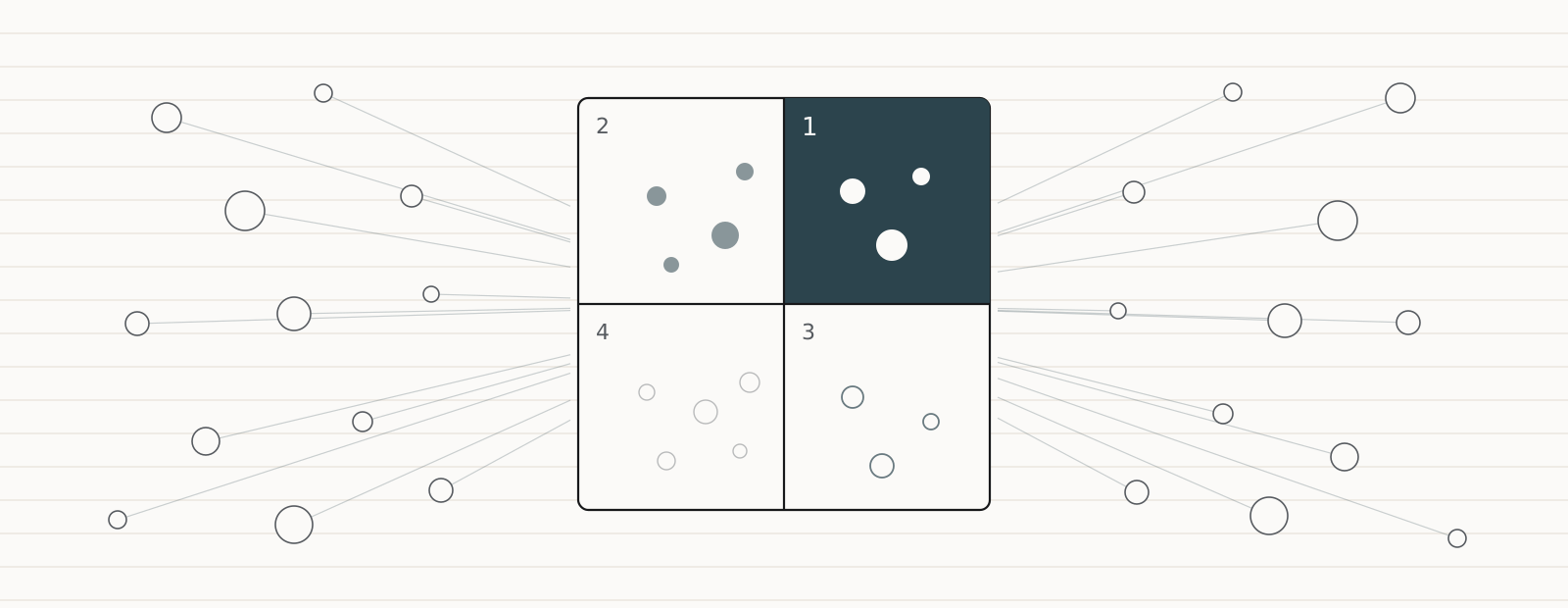
Every product team has more good ideas than people to build them. The question is never "is this a good idea?" It is "is this a better idea than the other nineteen, right now, with this team?" Prioritization frameworks exist for that second question. Here is what each of the four famous ones actually answers, where each one breaks, and how I used two of them on a real decision.
What is a prioritization framework, and do you even need one?
A prioritization framework is a shared rule for comparing options, so a decision can be explained and challenged. It does not make the decision for you; it makes the trade-off visible and arguable.
Nielsen Norman Group put it well in their overview of prioritization methods (2021): these methods base decisions on objective, relevant criteria instead of subjective opinions, and the best one depends on your project context, team culture and success criteria. In other words, there is no winner. There is a fit.
The common critique is that frameworks are opinion laundering: you decide what you wanted anyway, then pick numbers that agree with you. That critique is fair. It is also the best argument for using one. When your opinion is written down as "Reach: 4,000, Confidence: 80%", someone can point at the 80% and ask where it came from. When it lives only in your head, nobody can.
So do you need one? If three people agree on what to build next, no. If the same argument keeps coming back every sprint, yes. The framework is how you stop having it.
What is the MoSCoW method?
MoSCoW sorts requirements into Must have, Should have, Could have and Won't have this time, always for a fixed timebox. Its rule of thumb: Must Haves take no more than about 60% of the effort.
The method was developed by Dai Clegg in 1994, while he was at Oracle, for rapid application development, and later became the backbone of the DSDM agile framework. The lowercase o's are just there to make it pronounceable.
- Must have: without it, the release is useless, illegal or unsafe. Not "very important". Useless.
- Should have: important, painful to leave out, but there is a workaround.
- Could have: nice, small, the first thing to go when time runs short.
- Won't have this time: agreed out of scope for this timebox.
The detail most teams miss is the budget. The Agile Business Consortium's DSDM guidance recommends that Must Haves take typically no more than 60% of the effort, with a pool of Could Haves around 20% as contingency. Effort, not item count. Ten small Musts can be fine; three huge ones can sink the release.
What does "Won't have this time" really mean?
It means "not in this timebox, and we agreed on that out loud." It is not "never", and it is not a polite way to bury an idea; it is a decision with a date attached.
This is the most underrated bucket in the whole method. Writing an item down as Won't-this-time ends the side conversations about it, protects the team from scope creep, and gives the person who asked for it a straight answer. The next timebox starts by looking at that list again.
How do you calculate a RICE score?
RICE = (Reach × Impact × Confidence) ÷ Effort. Reach is people per period, Impact a 3 to 0.25 scale, Confidence a percentage, and Effort person-months; higher scores go first.
RICE was created at Intercom and described by Sean McBride in "RICE: Simple prioritization for product managers". The four factors:
- Reach: how many people the idea affects in a defined period, for example customers per quarter.
- Impact: how much it moves each person, on a fixed scale: 3 massive, 2 high, 1 medium, 0.5 low, 0.25 minimal.
- Confidence: how sure you are of the other numbers: 100% high, 80% medium, 50% low.
- Effort: total person-months across product, design and engineering. It divides, because more effort is a cost.
A short worked example, with made-up numbers for illustration only:
| Idea | Reach | Impact | Confidence | Effort | Score |
|---|---|---|---|---|---|
| A. New reporting dashboard | 2,000 | 1 | 80% | 2 | 800 |
| B. AI assistant | 500 | 3 | 50% | 1 | 750 |
| C. Clearer error messages | 4,000 | 0.5 | 100% | 0.5 | 4,000 |
The boring one wins by a mile. That is RICE at its best: it pulls attention away from the exciting idea and toward the one that quietly helps the most people for the least work.
Why do RICE scores get gamed, and how do you stop it?
They get gamed because every input is an estimate, and the person who wants the feature does the estimating. Stop it by making inputs public, capping confidence without data, and treating the score as a conversation starter.
- Inputs public. Every number sits in a shared sheet with one line on where it came from. A reach of 4,000 with "from last quarter's analytics" beats a reach of 10,000 with no source.
- Confidence capped. No data, no 100%. McBride's own scale stops at 50% for low confidence, and anything below that he treats as a moonshot.
- The score starts the talk, it does not end it. If idea #7 feels more important than #2, that feeling is information. Find the input you disagree with and argue about that.
What is the Kano model?
The Kano model classifies features by how they affect satisfaction: must-be, one-dimensional (performance), attractive (delighters), indifferent and reverse. It tells you what kind of value a feature brings; it does not rank them.
It comes from Noriaki Kano and colleagues, in the 1984 paper "Attractive Quality and Must-Be Quality". The categories:
- Must-be: nobody thanks you for it, everybody leaves without it. Login that works. Data that saves.
- One-dimensional (performance): more is better, in a straight line. Faster load, more storage.
- Attractive (delighters): nobody asked, nobody misses it when absent, and it creates real delight when present.
- Indifferent: users do not care either way. Expensive silence.
- Reverse: some users actively dislike it. Usually the feature someone in the office loves.
One more thing, and it matters: delighters do not stay delighters. What surprised people a few years ago becomes the thing they expect, and then the thing they complain about when it is missing. A Kano analysis has a shelf life.
Kano is a research tool, so it pairs naturally with understanding the job users are trying to get done. If you want to go deeper on that side, I wrote about Jobs to Be Done and outcome-driven innovation, which is a good way to find out what your must-bes even are.
What is the Eisenhower matrix, and is it a product framework?
The Eisenhower matrix sorts tasks into four boxes by urgent and important: do, schedule, delegate, drop. It is a tool for your own week, not for deciding what goes on a product roadmap.
The attribution is more interesting than most posts admit. In his August 1954 address in Evanston, Eisenhower quoted "a former college president" who had said he had two kinds of problems, the urgent and the important. So the line was not originally his, as Quote Investigator traces in detail. The 2x2 grid with four quadrants came much later, popularized by Stephen Covey in The 7 Habits of Highly Effective People (1989).
For a product manager it is genuinely useful, just aimed at the right target: your calendar. The important-but-not-urgent box is where discovery, user interviews and strategy live, and it is the first box to get eaten by urgent Slack messages. If you want to see where your week actually goes, TimeLens in my Product Toolkit was built for exactly that.
What it cannot do is rank features. "Urgent" for a roadmap item usually means someone is shouting, and "important" without reach or effort is just an opinion with a nicer name.
Which prioritization framework should you use when?
Kano to understand what users value, RICE to rank a long list, MoSCoW to cut scope for a deadline, Eisenhower for your own calendar. They are not rivals; most good decisions use two of them in sequence.
| Framework | What it answers | Output | Best for | Data you need | Where it fails | Origin (year) |
|---|---|---|---|---|---|---|
| MoSCoW | What is in this release, and what is out? | Four buckets | Cutting scope for a fixed deadline | Effort estimates, a shared goal for the timebox | Everything becomes a Must | Dai Clegg, Oracle (1994) |
| RICE | Which idea gives the most value per unit of work? | A ranked score | Ranking a long backlog | Usage numbers, effort estimates | Inputs get inflated to win | Sean McBride, Intercom (2018) |
| Kano | What kind of value does this feature bring? | Categories, no ranking | Understanding users before building | A user survey or real research | Delighters turn into basics over time | Noriaki Kano et al. (1984) |
| Eisenhower | What should I do first today? | Four action boxes | Your own week | Your task list, honestly sorted | Used on a roadmap, it rewards whoever shouts | Eisenhower speech (1954), Covey grid (1989) |
The sequence I see work most often: Kano when you are still learning what users value, RICE when the backlog has more than about ten serious candidates, and MoSCoW when a date is fixed and something has to give. Eisenhower runs underneath all of them, protecting the time you need to do the other three properly.
And once you have prioritized, someone has to write down what is actually being built. That is the next step: how to write a PRD that people actually read.
What does this look like on a real decision?
At Ongage, an email marketing platform, I used RICE to frame a signup question and MoSCoW to decide it. We moved some questions out of onboarding into the product, and onboarding completion improved by about 8%.
I have used RICE and MoSCoW together at several companies. This is the one I come back to, because it is so small and it still mattered.
The question was simple: when a new user signs up, do we ask for certain information upfront, in the signup and onboarding questions, or later, inside the product? Everyone in the room had a reason to want their question at the start. Sales wanted to qualify. The product wanted to configure. Fair reasons, all of them.
RICE framed it. I did not need precise numbers to see the shape. Reach was every single signup, the widest reach anything in the product could have. Effort was low: we were moving questions, not building a feature. With reach that wide and effort that low, even a modest impact made it worth doing now, not next quarter.
MoSCoW decided it. For each question at signup, we asked the Must have test: without this answer, can the person get in? Only what was truly needed to open the account stayed a Must at signup. The configuration details became Won't have this time, at signup. They did not disappear. They moved to the configuration step inside the product, because by then the person was already in, and already had a reason to answer.
We removed those questions from onboarding, and onboarding completion improved by about 8%. No new feature. Just fewer questions, asked at a better moment. 😉
What if you are a founder without a PM?
Pick one framework, not four, and run a 30-minute weekly ritual with it. Consistency matters more than which framework you choose; the ritual is what turns opinions into decisions.
Here is the version I give founders:
- Choose one. Many ideas and some data: RICE. A launch date that will not move: MoSCoW.
- Keep one list. Every idea goes into the same place, with its inputs written next to it.
- 30 minutes, same time every week. Re-score anything new, look at the top three, and decide what is Won't-this-time out loud.
- Protect your own week. Run the Eisenhower test on your calendar, separately, so the important work does not get eaten.
If you want a head start, PrioritizePro in the Product Toolkit runs this kind of scoring for you, and TimeLens handles the calendar side. And if you would rather have someone in the room who has done this many times, that is what I do as a fractional PM: a few days a week, inside your team, deciding what comes next with you.
FAQ
Can you combine MoSCoW and RICE?
Yes, and they work best together. Use RICE to rank the backlog, then MoSCoW to draw the line for a specific release, taking items from the top of the RICE list as Must Haves until they reach about 60% of the effort.
What is the difference between RICE and ICE?
ICE scores Impact, Confidence and Ease, and leaves Reach out. That makes it faster for a quick list of experiments, while RICE is safer when ideas reach very different numbers of people.
How many Must Haves are too many?
The DSDM guidance is no more than about 60% of the effort in a timebox, measured in effort, not in number of items. If your Must Haves fill the whole timebox, there is no contingency left, and the first surprise becomes a missed deadline.
Is the Eisenhower matrix useful for product managers?
Yes, for their own week, not for the roadmap. It helps protect time for important work like discovery and strategy, but it says nothing about what users value or what a feature costs.
What next?
Pick the question first, then the framework. Not sure what users value? Kano. Too many ideas? RICE. A deadline? MoSCoW. A week that disappears? Eisenhower. If you want help running this with your team, with someone who has made these calls before, see how I work as a fractional PM, or book a 30-minute call and bring your backlog.
Enjoyed this? Get the next edition in your inbox.
Subscribe